Tuesday, December 13, 2022

Cultivating Intergenerational Kindness

Benedictine monasteries have always practiced intergenerational living. In his Rule, St. Benedict states clearly, “The younger monks, then, must respect their seniors, and the seniors must love their juniors…. Whenever brothers meet, the junior asks his senior for a blessing. When an older monk comes by, the younger rises and offers him a seat… In this way, they do what the words of Scripture say: They should each try to be the first to show respect to the other (Rom 12:10).”

Many young people today don’t grow up around their grandparents, so they miss out on having nurturing relationships with their elders. For Ruby Chitsey, this was remedied when her mom suggested that she volunteer at her workplace, a nursing home. As Ruby developed relationships with the residents, she noticed that they didn’t have money to spend on things like haircuts, new shoes, or small treats, such as a favorite type of candy or a new novel. Ruby decided to remedy that, and her efforts mushroomed into the charitable organization “Three Wishes for Ruby’s Residents.” Since 2019 Ruby has raised more than $400,000 for her cause and has granted wishes for 25,000 nursing home seniors.

Ruby’s work was highlighted on the CNN’s 2022 Heroes Special, where she said something that caught my attention: “My hobby is kindness.” Most of us think of a hobby as a way to relieve stress or to express our creative instincts. However, as Ruby has shown, hobbies that entail outreach to others can help us practice kindness until it becomes a way of life.

As any Benedictine can attest, intergenerational living provides a fertile ground for practicing kindness, and we should foster these relationships in our society. As the writer Henry James noted, “Three things in human life are important. The first is to be kind. The second is to be kind. And the third is to be kind.”

Wednesday, December 7, 2022

Advent Emptiness

Advent calls us to have an empty head and an empty heart.

If that sounds rather foolish and bleak, consider the following advice by Bruce Lee: “Empty your cup so it may be filled.”

If our heads are full of what we think God is supposed to look like and act like, we risk missing the Messiah in our midst. Even John the Baptist had his doubts about whether Jesus was “the One who is to come”; he apparently expected a more triumphant, king-like figure, along the lines of King David. Yet if we acknowledge that God is uncontainable, should we be surprised at his choice to be born of a young Jewish maiden from the backwater of Nazareth and to spend his time healing and teaching rather than smiting others and residing in a castle?

If our hearts are full of our own dreams and desires, we risk missing the invitation to bring Christ to birth through service to others who need us in unexpected ways. Mary of Nazareth had questions about how she, a virgin, could conceive and bear God’s son, but she entrusted her heart to her God and became the mother of Jesus, God with us.

Let us put on the mind and heart of Advent—open, receptive, and empty of preconceived notions about God’s intentions and how our lives should unfold. Then our head and our heart will be prepared to recognize and receive God in ways beyond our imagining. 

Monday, November 28, 2022

Approaching Advent with the Heart of a Child

Spending time with a toddler is a great way to begin Advent, as I discovered during a Thanksgiving visit with my 13-month-old great-nephew, Robin.

• I had to wait in anticipation for him and his parents to arrive              

• I learned to be vigilant to keep small items and breakables out of his grasp

• I observed the art of welcoming as he gave a hug to every teddy bear in sight

• I awakened to the wonder of exploring the world as he delighted in everything he encountered

• I remembered how to be still as he rested in his mother’s arms

I was also grateful that Robin’s parents said yes to bringing him into the world, echoing Mary’s yes when she was invited to give birth to Jesus. We all are offered various opportunities to be open to new life, and even though it often leads to a certain degree of disruption, inconvenience, and self-sacrifice, saying yes leads to a richer and more satisfying life.

May you approach this Advent with the heart of a child as we prepare to celebrate the birth of Jesus, who never lost the capacity to welcome others, to be awake to God’s presence in the world, and to rest in the stillness of prayer.


Tuesday, November 22, 2022

The Bridge of Gratitude

When I talked to my younger brother the other day, he said his young step-grandchildren had never been taught why we celebrate Thanksgiving. I suggested that before his family begins their holiday meal, he might ask everyone around the table to name something they are thankful for.

Developing “an attitude of gratitude” is an important step in cultivating contentment, which is one of the keys to the good life. Abraham Lincoln noted that “Most people are about as happy as they make up their minds to be,” and recognizing our blessings instead of yearning for what we don’t have sets us on the road to happiness.

Furthermore, the Thanksgiving holiday is a bridge to Advent, because gratitude is an important way that we “make straight the way of the Lord.” As Joan Chittister explains, “Christmas is the obligation to see that everything leads us directly to God, to realize that there is no one, nothing on earth that is not the way to God for me. …The moment we begin to really celebrate Christmas, to look at everyone and everything as a revelation of God, to say ‘thank you’ for them … racism would be over, war would be no more, world hunger would disappear, everything would be gift, everyone would be sacred.”

This Thanksgiving, let’s set our Advent intention to make straight the way of the Lord by being thankful — even for dry turkey, family members whose political viewpoints differ from ours, and challenging travel conditions. Everything leads directly to Emmanuel, God with us, and so we can trust the words that the mystic Julian of Norwich heard Jesus say in a vision: “All shall be well, all shall be well, and all manner of thing shall be well.”

Wednesday, November 16, 2022

The One Thing Necessary

The impressionist painter Claude Monet said, “Everyone discusses my art and pretends to understand, as if it were necessary to understand, when it is simply necessary to love.” I can easily imagine God voicing a variation of this sentiment: “Everyone discusses the nature of my being and pretends to understand, as if it were necessary to understand, when it is simply necessary to love.”

Many Christological and Trinitarian treatises, books, and homilies have been written through the centuries. However, Richard Rohr, OFM, says that we come to know God by loving God. St. Gertrude the Great, whose Feast we celebrate today, demonstrated the truth of that insight. St. Gertrude is usually depicted holding a heart because of her mystical connection to the heart of Jesus, which is a clear and vivid image of Christ who became flesh out of love for us.

While some of the saints leave us with an impression of a rather severe, joyless life, Gertrude saw herself as “happy, carefree, and liberated.” Her wholehearted devotion to God allowed her to empty herself to make possible the Spirit’s in-dwelling, which gave her an inner freedom to overcome fear and worries and unconditionally follow her convictions.

We might not have mystical visions as St. Gertrude did, but we can follow her example of emptying ourselves of all that keeps us from God so we can love God wholeheartedly and without fear. Then we too will bear great fruit and, as it says of the wholehearted in Psalm 37, God will watch over our lives and give us an inheritance that lasts forever—an inheritance in the life and love of the Trinity.

Friday, November 11, 2022

Gifts of Strength and Love

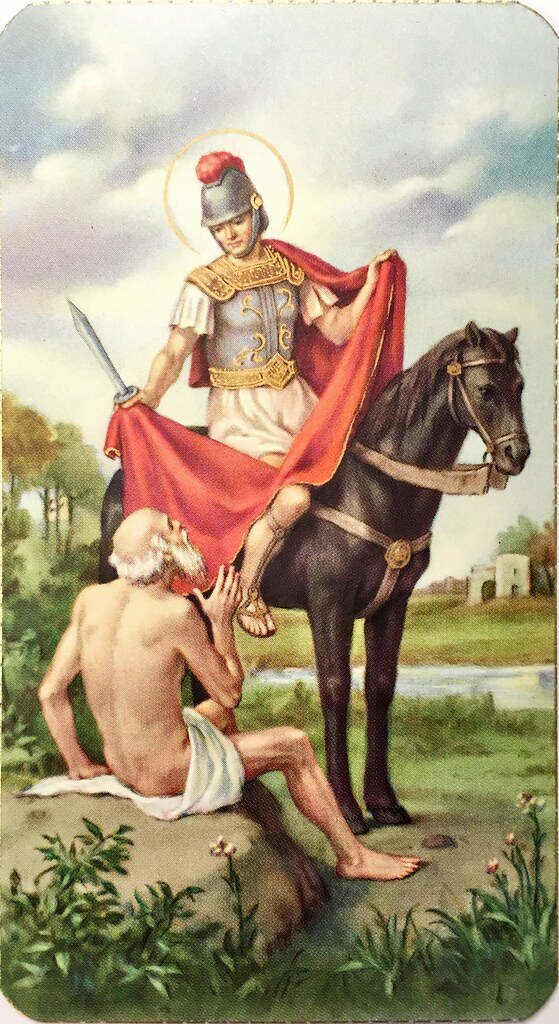
November 11 is the Feast of St. Martin of Tours, a 4th-century monk who was close to the heart of St. Benedict. Martin became a catechumen at age 15, to the displeasure of his father, a Roman officer, who compelled him to join the army. A legend about St. Martin says that during his time of military service, he encountered an ill-clad beggar and cut his cloak in two, giving half to the poor man. That night, Martin had a dream in which he saw Jesus wearing the half-cloak the had given to the beggar. Not long thereafter, Martin was baptized and sought to live as a monk.

St. Benedict thought so highly of St. Martin that when Benedict destroyed the old temple of the god Apollo at Montecassino, he built a shrine dedicated to St. Martin at this site. St. Benedict says in his Rule that we are to welcome all guests as Christ, and it is plausible to think that the legend of St. Martin’s generosity to the beggar and his subsequent dream of seeing Jesus wearing his cloak inspired this teaching of St. Benedict. St. Martin’s act also echoes Jesus’ proclamation “I was naked and you clothed me … whatever you did for one of these least brothers of mine, you did for me” (Mt 25: 36, 40).

Psalm 62 notes that “Time and time again God said, ‘Strength and love are mine to give.’” St. Martin’s strength in turning aside from a secure, socially acceptable career and his compassion in responding to another’s need were gifts from God. These gifts are offered to all of us; what is unique about St. Martin is his choice to put God’s strength and love to use in the service of others.

I could easily give away half of the clothing I own to others who are less fortunate and still have plenty to wear. The story about St. Martin’s generosity invites all of us to consider whether we are using the blessings God has given us to serve our brothers and sisters with strength and love.

Tuesday, November 1, 2022

Saintly Vision

Halloween is over, and I’m missing it. Not so much because of the candy (there’s still plenty of that to be found) or the costumes (dressing up isn’t the only way to be creative and playful). No, what I miss is the spirit of inclusiveness and kindness that abounds on Halloween. As Steve Garnass-Holmes says, “Halloween is a day when we get it right. Strangers come to us, beautiful, ugly, odd, or scary, and we accept them all without question, compliment them, treat them kindly, and give them good things. Why don’t we live like that?”


The day after Halloween, the Feast of All Saints, is set apart to honor the people who have
lived like that. Not all of them have officially been designated saints; an example is Dorothy Day, who opened houses of hospitality to provide places where the beautiful, ugly, odd, and scary would be welcomed and treated kindly. She never wanted to be called a saint anyway, because she knew that we don’t think we can do the things the saints have done. Yet as many thousands of people who have staffed Catholic Worker houses can attest, one doesn’t have to be canonized to make a pot of soup, clean bathrooms, sort through donations of clothing, or listen to a homeless person’s story.

Where the saints excel is in developing the vision to see Christ in others and treat them kindly not just on Halloween but on every day of the year. Every time October 31 rolls around, we are given the collective opportunity to practice hospitality and generosity. There’s nothing that says we have to wait a whole year to do it again.